
Share This Article
Hello there human friends. Cache here, your favorite curious cat, curling up on the warm keyboard to talk about technology.
Artificial intelligence has changed from a fun little toy into something we use every single day. But with tech companies updating their smart tools all the time, picking the right assistant feels like chasing a fast red laser pointer around the room. You think you have a handle on it, and then it jumps somewhere else.
Right now, three huge names dominate the entire playground. We have OpenAI’s ChatGPT, Anthropic’s Claude, and Google’s Gemini.
All three of these options can write long papers, fix broken code, and make big documents easy to read. But under the hood, they work quite differently, speed along at different rates, and offer unique tricks.
In this Complete A-to-Z Guide to AI Chatbots: ChatGPT vs. Claude vs. Gemini, I am going to break down everything you need to know in plain language. We will look at how smart they are with logic, how well they write stories, how good they are at coding, how easily they connect to your other tools, what they cost, and how much information they can remember at once. By the end of our chat, you will know exactly which helper deserves a spot on your desk.
The Big Three AI Chatbots: An Overview
Before we start comparing every little detail, it is super important to understand the background and thinking behind each of these smart tools. Knowing where they came from makes it much easier to see why they work the way they do today.
OpenAI ChatGPT
When OpenAI launched ChatGPT near the end of 2022, it ignited the generative artificial intelligence boom that changed how we work on our computers. Built on OpenAI’s foundational model series, ChatGPT is designed as an all-in-one conversational workstation for your desk.
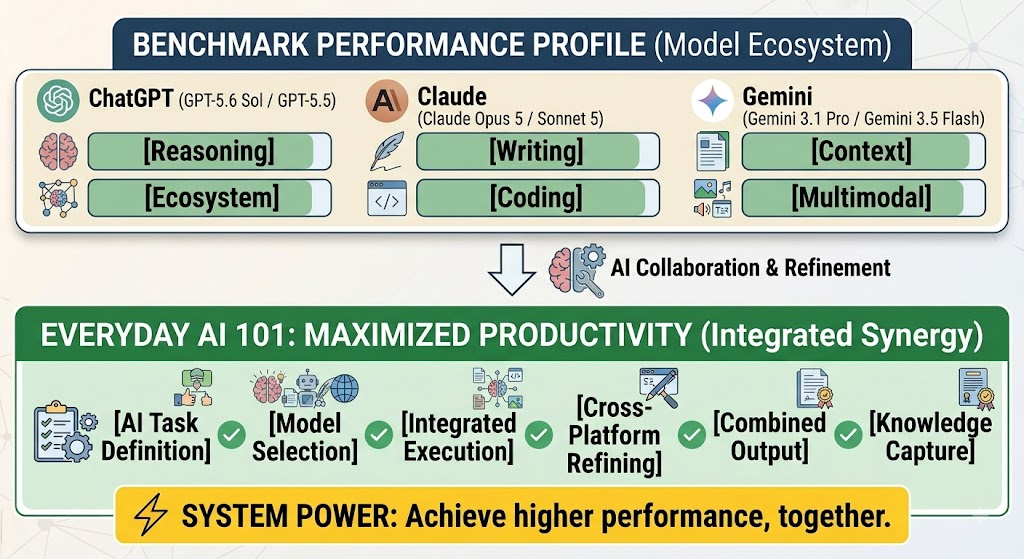
Today, ChatGPT runs on OpenAI’s unified engine architecture, featuring models like GPT-5.5 and the flagship GPT-5.6 Sol. It really shines when it comes to feature depth. You get native image creation, advanced data analysis tools, real-time web search, custom GPT builders, and smooth voice interaction through GPT-Live. If you want a flexible helper that jumps between almost any daily task, ChatGPT set the original benchmark for what a general assistant can do.
Anthropic Claude
Founded by former OpenAI researchers, Anthropic places a strong focus on safety, constitutional AI rules, and natural human-like expression. Powered by models like Claude 3.5 Sonnet, Claude Opus 4.8, and Sonnet 5, the Claude family has earned a stellar reputation among writers, researchers, and software developers.
Claude stands out for its high writing fluency, precise code generation, and massive context handling. It can read through huge piles of text without getting confused or losing track of subtle, nuanced details. If you need clean, friendly long-form writing or careful code reviews, Claude is a top choice.
Google Gemini
Formerly known as Bard, Google’s Gemini was built to be natively multimodal right from the start. Built on models like Gemini 2.5 Pro, Gemini 3.1 Pro, and Gemini 3.5 Flash, Gemini was trained from the ground up on audio, video, images, and text simultaneously.
When you combine those native skills with direct integration into Google Workspace tools like Docs, Gmail, and Google Drive, plus an industry-leading context window of up to 2 million tokens, Gemini is built for seamless productivity across your whole digital environment.
Core Feature Comparison at a Glance
For quick evaluation, here is how the flagship paid tiers of each platform stack up against each other:
| Feature Category | OpenAI ChatGPT (Plus / Pro) | Anthropic Claude (Pro) | Google Gemini (Advanced) |
| Primary Flagship Model | GPT-5.5 / GPT-5.6 Sol | Claude 3.5 Sonnet / Claude Opus 4.8 / Sonnet 5 | Gemini 3.1 Pro / Gemini 3.5 Flash |
| Standard Pricing | $20 / month | $20 / month | $20 / month |
| Context Window | Up to 1,050,000 tokens (~780,000 words) | Up to 1,000,000 tokens (~750,000 words) | Up to 2,000,000 tokens (~1.5M words) |
| Multimodal Inputs | Text, Images, Documents, Voice | Text, Images, Documents | Text, Images, Documents, Audio, Video |
| Built-in Image Generation | Yes (DALL-E 3 / GPT-5 Vision-Image) | No (Text & Analysis only) | Yes (Imagen 3 / Nano Banana 2) |
| Live Web Browsing | Superior (SearchGPT integration) | Native Search Capabilities | Native (Google Search Integration) |
| Code Interpreter & Sandbox | Advanced (Python Code Execution) | Visual Artifacts Sandbox | Google Colab & Python Execution |
| Unique Highlight | Custom GPTs & GPT-Live Voice | Artifacts & Superior Writing Nuance | Massive 2M Context & Workspace Sync |
Cache’s Quick Take on the Numbers
Paws down, looking at a feature table is the fastest way to spot which tool fits your style without getting tangled in tech jargon!
If you want an all-in-one workstation that can generate artwork, run live Python code, and talk back using natural voice, ChatGPT gives you a massive toolbox. If your work centers on writing natural text, crafting clean code, and watching web apps build live in a separate window, Claude Pro is your cozy spot. And if you have massive piles of data, video files, or long Google Drive documents to organize, Gemini Advanced holds the crown with its gigantic memory capacity.
Benchmark & Performance Evaluation
When you are choosing an AI helper, raw intelligence, logical reasoning, and processing speed are key factors. Independent AI evaluation groups, such as Artificial Analysis, routinely test these models across diverse real-world workloads to see who takes top honors.
1. Complex Reasoning and Mathematics
OpenAI’s flagships, like GPT-5.6 Sol and GPT-5.5, feature adaptive thinking modes that pause to process complex steps before answering. On competitive logic puzzles, multi-step math evaluations like LiveBench, and advanced science benchmarks, OpenAI models consistently deliver elite problem-solving scores.
Anthropic’s Claude Opus 5 and Claude Sonnet 5 offer exceptionally reliable step-by-step logic. Claude excels at avoiding silly factual errors while handling multi-layered analytical tasks smoothly.
Google’s Gemini 3.1 Pro scores near human-panel levels on academic tests like GPQA Diamond and ARC-AGI. However, for multi-step logical deduction and step-by-step math proofs, many users still reach for OpenAI’s Sol series or Claude’s Opus models.
2. Context Window and Reading Big Files
A model’s context window determines how much text or data it can read in a single prompt. Think of it as how big a book the tool can hold in its paws at once!
Google’s Gemini 3.1 Pro leads the pack with a massive 2-million-token context window. You can upload entire video files, hours of audio recordings, giant code repositories, or multiple textbooks at once, and Gemini will accurately retrieve specific details without losing its place.
Anthropic’s Claude Opus 5 offers a generous 1-million-token window. Claude is famous for maintaining near-perfect context recall across its entire prompt size, avoiding the common lost-in-the-middle issue where details get fuzzy.
OpenAI’s GPT-5.6 Sol also features a expanded 1.1-million-token window. While plenty big for heavy document analysis, daily research, and massive files, Gemini still holds the absolute maximum capacity crown for giant media archives.
Detailed Use-Case Breakdown: Which Model Wins Where?
Different human workflows call for completely different capabilities. Here is how our three major helpers perform across key real-world applications!
1. Best for Coding and Software Development
Winner: Anthropic Claude
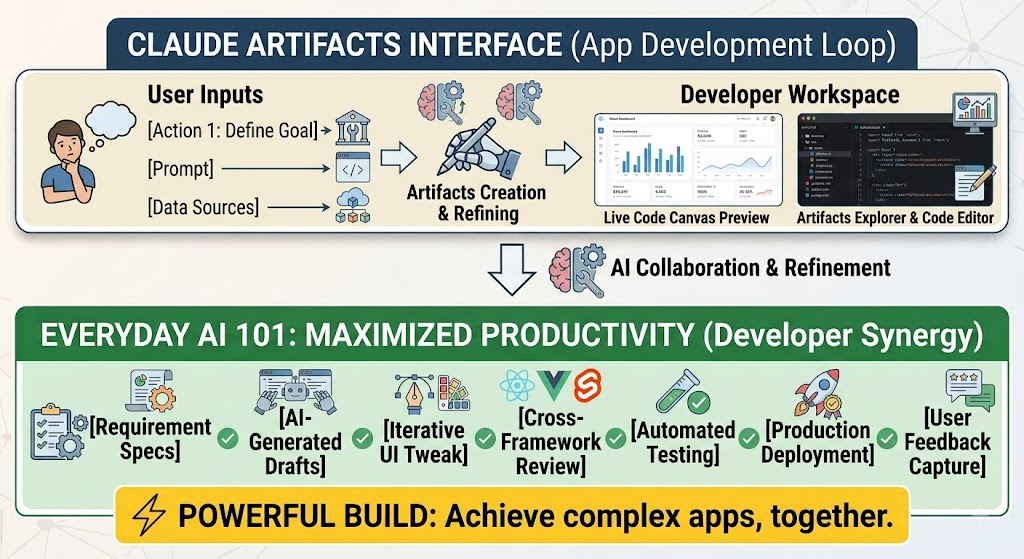
While ChatGPT is a strong programming assistant, developers consistently choose Claude 3.5 Sonnet as their absolute favorite tool for software engineering.
- Precision and Architectural Understanding: Claude writes clean, modular, and modern code with significantly fewer syntax errors, missing dependencies, or outdated functions.
- Artifacts Workspace: Claude includes “Artifacts,” a dynamic split-screen interactive window where you can view, edit, and run rendered React applications, HTML web pages, or SVG diagrams directly alongside your chat.
- Code Refactoring: Claude excels at scanning thousands of lines of existing code to identify bugs, reorganize structures, and apply fixes without breaking other parts of your project.
2. Best for Creative Writing & Content Creation
Winner: Anthropic Claude
Most AI language models tend to produce robotic, formulaic text filled with tired AI cliches like “In today’s fast-paced digital world” or “delve into.”
- Claude stands out by producing natural, human-sounding prose with varied sentence lengths and comfortable rhythm. It adapts seamlessly to specific voices, understands gentle irony or humor, and maintains consistent story flow over long documents.
- ChatGPT is versatile and great for building quick outlines, brainstorming angles, and drafting fast social media posts. However, its raw draft output often needs a few extra editing passes to sound completely natural.
- Gemini produces clear and direct text, but its tone tends to be factual and concise, making it better suited for structured business reports than creative storytelling.
3. Best for Data Analysis & Multi-Tool Utility
Winner: OpenAI ChatGPT
For general productivity, day-to-day flexibility, and multi-modal tasks, ChatGPT offers the most complete feature set.
- Advanced Data Analysis: ChatGPT features a native Python sandbox environment. You can upload raw CSV files, Excel spreadsheets, or JSON datasets, and ChatGPT will clean the data, calculate statistics, generate downloadable charts, and run predictive models automatically.
- Custom GPTs and Ecosystem: OpenAI provides a store of custom GPTs configured for specific workflows, such as specialized SEO analysis, academic research, or graphic design.
- Voice and Vision: ChatGPT’s Advanced Voice Mode delivers natural conversational audio interactions with realistic pacing, intonation, and instant response times.
W
4. Best for Research & Workspace Integration
Winner: Google Gemini
If your daily routine revolves around Google tools, Gemini Advanced integrates seamlessly into your digital workspace.
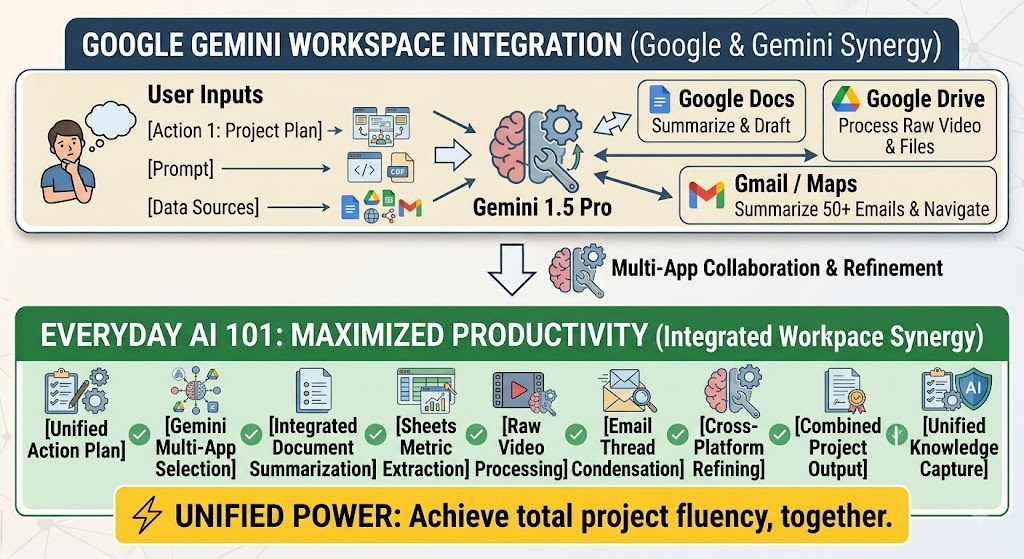
- Direct Workspace Sync: Using
@ Extensions, you can direct Gemini to pull information directly from your Google Drive files, summarize unread email threads in Gmail, or compile travel logistics using Google Maps and Flights. - Native Multimodal Processing: You can upload a 45-minute recorded presentation or video lecture directly into Gemini, and it will analyze the visual and spoken content, summarize key takeaways, and answer your questions accur
Deep Dive: Pros & Cons of Each AI Model
Let us take a closer, side-by-side look at the real-world advantages and trade-offs of each platform so you can weigh them easily.
OpenAI ChatGPT
- Pros:
- Highly versatile, feature-rich ecosystem covering text, vision, built-in image creation, and fluid GPT-Live voice conversations.
- Advanced Python sandbox environment that cleans datasets, runs calculations, and exports downloadable charts.
- Specialized reasoning models that tackle complex math, multi-step logic, and competitive science problems.
- Massive library of third-party Custom GPTs tailored for specific user tasks.
- Cons:
- Free tier usage limits can feel restrictive during peak traffic hours.
- Creative prose can sound a bit robotic or formulaic without precise prompt guidance.
- Smaller overall context window limit compared to Google Gemini and Anthropic Claude.
Anthropic Claude
Pros:
- Exceptionally natural, warm, and nuanced long-form prose that avoids common AI cliches.
- Top-tier performance for writing, refactoring, and debugging software code.
- Interactive Artifacts canvas for running, editing, and previewing web apps and diagrams live in your browser.
- Generous 1-million-token context window with reliable retrieval accuracy across long files.
Cons:
- Lacks native built-in image generation tools within the chat interface.
- Strict rate limits on message volume within short time windows, even for paid subscribers.
- Does not offer a standalone Python execution sandbox for direct dataset manipulation.
Google Gemini
Pros:
- Market-leading 2-million-token context window capable of handling massive files, long video recordings, and large code bases.
- True native multimodal processing for text, images, video, and audio inputs simultaneously.
- Seamless deep integration into Google Workspace tools like Gmail, Drive, Docs, and Calendar.
- High-quality image generation paired with fast response speeds across devices.
Cons:
- Response quality can occasionally feel more factual and concise compared to Claude’s rich writing style.
- Content guardrails can sometimes trigger overly cautious refusals on harmless queries.
- Can occasionally struggle with highly intricate, multi-layered software engineering tasks compared to Claude.
Pricing & Subscription Model Breakdown
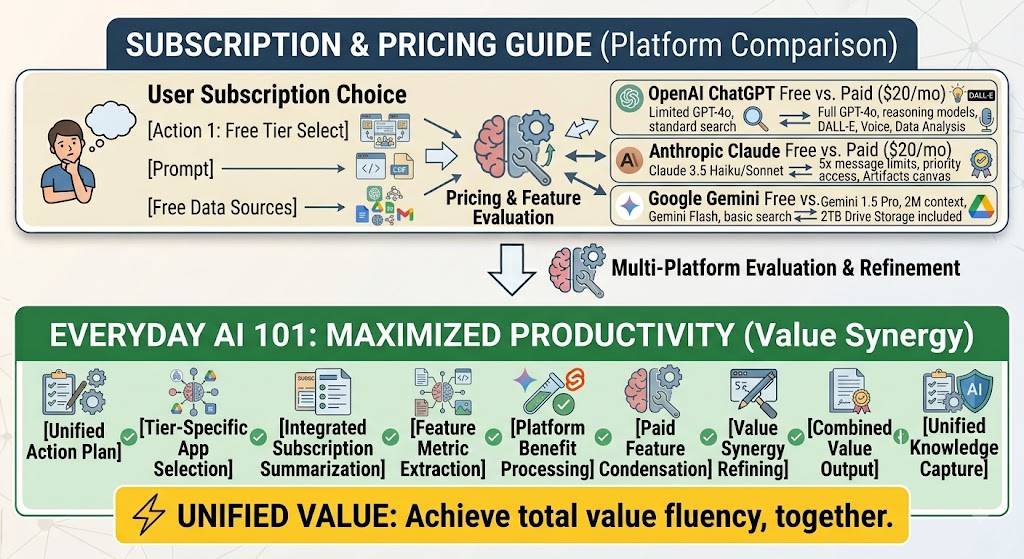
All three providers share a similar subscription structure, but the total value depends on which extra tools align with your daily routine:
| Service Platform | Free Tier Access | Standard Paid Tier ($20 / month) |
| OpenAI ChatGPT | Capped access to flagship models, basic web search | Full access to flagship engines, reasoning models, image generation, voice mode, and data sandbox |
| Anthropic Claude | Access to Claude 3.5 Sonnet with daily message caps | 5x higher message limits, priority access during peak hours, and full access to the Artifacts workspace |
| Google Gemini | Access to Gemini Flash with fast response speeds | Full access to Gemini Pro, 2M context window, and 2TB of Google One cloud storage included |
Cache’s Take on the Subscription Plans
- ChatGPT Plus ($20 / month): Paws down, this is the best choice if you want a complete, all-in-one assistant. It gives you native image generation, code execution in a Python sandbox, custom GPT builders, and smooth, real-time voice conversation.
- Claude Pro ($20 / month): The ideal choice for professional coders, full-stack developers, copywriters, and authors. It focuses on writing nuanced, human-sounding prose, generating clean code, and letting you preview web components live on an interactive canvas.
- Google AI Premium ($20 / month): An excellent option for Google power users. The $20 monthly plan includes 2TB of Google One cloud storage, making it super cost-effective if you already pay for online storage while giving you Gemini features right inside Gmail, Docs, and Drive.
How to Choose the Right AI Model for Your Needs
To select the best helper for your desk, match your primary daily workflow against these simple scenarios:
- Choose ChatGPT if: You need a versatile, multi-purpose assistant capable of executing Python scripts, generating images, analyzing complex spreadsheets, and providing smooth voice interaction.
- Choose Claude if: Your primary tasks involve writing code, debugging software, drafting long-form essays, crafting marketing copy, or building web components visually in a live sandbox.
- Choose Gemini if: You work extensively within Google Workspace, need to process large audio and video files, or regularly analyze massive documents up to hundreds of thousands of words.
Final Verdict
There is no single “best” AI chatbot across every metric; instead, the ideal choice depends on your specific daily workflow:
- Anthropic Claude leads in writing nuance, narrative structure, visual app prototyping, and software engineering.
- OpenAI ChatGPT remains the most feature-rich, flexible all-rounder for daily utility, data analysis, custom bots, and voice interaction.
- Google Gemini is the unmatched leader for massive context processing and Google Workspace integration.
To optimize your productivity, consider testing all three free tiers. Many professionals find that combining two tools—such as Claude for writing and coding alongside ChatGPT or Gemini for research and multi-tool operations—delivers the ideal balance for their desk.
Frequently Asked Questions (FAQs)
Here are answers to the most common questions about ChatGPT, Claude, and Gemini, written directly from Cache’s desk to help you make the best choice for your computer setup.
Which AI chatbot is the most accurate?
Accuracy depends on the specific task you are working on. For complex logic, software engineering, and reading long documents, Claude and OpenAI’s reasoning models consistently deliver high precision with low hallucination rates. For real-time factual inquiries and current events, ChatGPT and Google Gemini leverage direct web search integration to cite live online sources.
Can I use these AI chatbots for free?
Yes! All three platforms provide useful free tiers:
ChatGPT: Free users get access to flagship capabilities, basic web search, and custom GPTs with temporary usage limits.
Claude: Free users get access to Claude Sonnet with daily message caps that reset every few hours.
Gemini: Free users get fast, unlimited access to Gemini Flash alongside basic Google Search capabilities.
Which AI model is best for coding and software development?
Anthropic Claude is widely considered the top choice by developers. It excels at writing modular, bug-free code, refactoring thousands of lines of existing projects, and letting you preview web apps live in its interactive Artifacts window. ChatGPT is a close second, especially for quick code snippets and running Python scripts in a data sandbox.
Which model is best for analyzing long PDF documents and video files?
Google Gemini Advanced leads this category with its massive 2-million-token context window, allowing you to upload entire books, raw video recordings, or heavy document folders at once. Claude Pro is a close second for text files, offering high recall precision across long documents up to 1 million tokens.
Do these AI platforms train on my personal conversations?
By default, free consumer tiers on ChatGPT and Gemini may use un-archived chat history to train future models, but you can easily opt out in your account settings. Anthropic Claude provides simple toggles to turn off model training and holds a strict 30-day data retention policy for opted-out users.
Is it worth paying for more than one AI subscription?
For everyday browsing and simple tasks, one paid subscription is plenty. However, many power users and professionals maintain a hybrid setup, using Claude Pro for deep writing and software engineering alongside ChatGPT Plus or Google AI Premium for web research, data analysis, and workspace integration.